Where Love Became Remembrance, and Craft Took Flight
In Konya, craftsmanship is not merely commercial manufacture—it is zikr, the physical act of divine remembrance.
From the melancholic breath of the Ney reed flute to the cosmic geometry of Seljuk glazed tiles and nail-free woodcarving, discover the 800-year living sanctuary where Jalal al-Din Rumi walked and master guilds give form to the unseen.
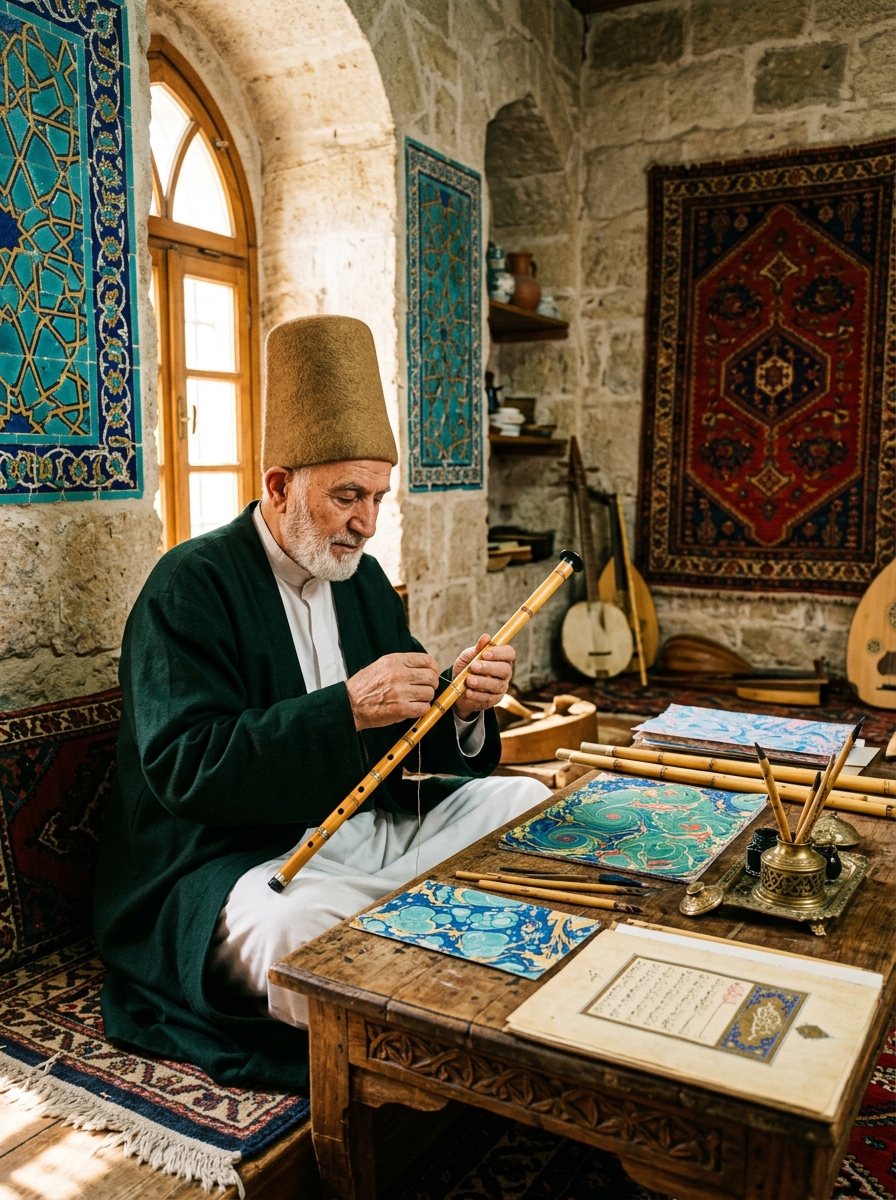
"Where sacred instruments, illuminated manuscripts, and nail-free woodcarving embody eight centuries of divine friendship and cosmic longing."
The Seven Chapters of Konya's Heritage
An illustrated editorial journey through the philosophical, architectural, and artisanal epochs that shaped the City of Rumi.
The Seljuk Cradle: When Konya Became the Capital of Devotion
Long before Konya echoed with the poetry of the Mevlevi order, it was transformed into the jewel of the Seljuk Empire under Sultan Alaeddin Keykubad. Rising in the high arid plateau of Central Anatolia, the city became an intellectual crossroads where Persian poetry, Byzantine stonemasonry, Arab philosophy, and Turkic craftsmanship interlocked. The monumental portals of its madrasas were chiseled with cosmic geometric star strapwork and high-relief ribbon calligraphy that mirrored celestial orbits, declaring that earthly construction must reflect cosmic order.
"Seljuk Konya established the physical and philosophical foundation for Islamic mystical craft: architectural proportion as prayer, and stone as a canvas for the infinite."
Jalal al-Din Rumi & The Birth of Ecstatic Remembrance
When Jalal al-Din Muhammad arrived in Konya fleeing the Mongol onslaught, he was already an accomplished jurist and theologian. Yet it was in Konya that his legal erudition dissolved into the boundless ocean of divine love. Dictating the six monumental volumes of the Masnavi (often revered as the Persian Quran of the mystics), Rumi taught that all beings yearn for their original divine source, just as a reed flute weeps when severed from its native reed-bed. This poetic awakening shifted Anatolian culture from dogmatic formalism into an immersive discipline of devotional remembrance (Zikr).
"For Rumi, the universe is continuously singing; the sacred artisan does not invent beauty, but merely removes the veils that conceal divine harmony."
Shams of Tabriz: The Catalyst of Divine Fire
In late 1244, a wandering dervish named Shams-i Tabrizi seized the reins of Rumi's horse in the dust of Konya. Shams challenged Rumi to understand that academic knowledge without burning love is mere burden. Their intense spiritual intimacy (sohbet) ignited Rumi's poetic voice and permanently remade Sufi literature. The presence of Shams demonstrated that sacred transformation requires a mirror: an artisan cannot master the grain of walnut or the hollow resonance of reed without surrendering the ego to the guidance of a spiritual master.
"The transmission of sacred art is relational: wisdom cannot be learned from a textbook alone, but passes heart-to-heart through living companionship."
The Mevlevi Tradition: Architecture of the Sema
Codified by Rumi's son Sultan Walad, the Mevlevi order organized the Sema ceremony into a profound liturgical cosmic drama. The Sema is not an improvised dance, but an astronomical movement where the Semazen (whirling dervish) orbits the Sheikh just as planets orbit the sun. Turning counter-clockwise with the right hand turned toward heaven to receive divine grace, and the left hand turned downward to give that blessing to creation, the dervish becomes a conduit of unconditional mercy, accompanied by the weeping lament of the Ney flute and the pulsing rhythm of the Kudüm drum.
"The Sema teaches that stillness and motion are one: at the still center of the whirling heart rests the unmoving presence of the Divine."
The Seljuk Aesthetic: Turquoise, Stone & Infinite Star Strapwork
The artistic identity of Konya is crystallized in its extraordinary ceramic and stone craft. The dome of Karatay Medrese remains the world's most transcendent vault of Seljuk tile mosaic, where thousands of hand-cut glazed ceramic pieces in luminous turquoise, cobalt, and gold luster assemble into 24-point celestial starbursts. Concurrently, Seljuk woodcarvers perfected Kündekari—an interlocking geometric joinery assembled entirely without glue or iron nails—allowing royal minbars and sanctuary doors to breathe and adapt through centuries of arid summer heat and freezing winter winds.
"Islamic geometric strapwork is an optical meditation: by following the interlocking lines to infinity, the human mind is released from the constraints of worldly illusion."
The Ahilik Guilds: The Sacred Honor of Labor
In medieval Konya, an artisan was never merely a commercial manufacturer. Under the Ahilik guild system (originating in Islamic Futuwwa or spiritual chivalry), no one could become a master without taking solemn vows of hospitality, generosity, honesty, and protection of the poor. Guild members began every workday with communal prayers; tools were treated as sacred instruments entrusted by God; and shoddy craftsmanship was cast out by the elders. The Ahilik ensured that the objects filling homes and sanctuaries carried pure moral intention and social blessing.
"A devotional object cannot carry spiritual sanctity if its creation involved exploitation; the purity of the artisan's intention is inseparable from the beauty of the work."
The Living Breath: Preserving Konya's Mystical Heritage
Today, the sacred heritage of Konya encounters the relentless speed of industrial mass reproduction. Plastic flutes replace seasoned Kargı reeds; synthetic ink mimics mineral Ebru marbling; and factory-printed tiles replicate hand-glazed Seljuk ceramics. Purple Soul stands alongside the surviving master ateliers in Konya and Anatolia—ensuring that the elderly Ney maker harvesting cane at the autumn waning moon, the Ebru artist crushing earth pigments, and the calligrapher trimming qalam reed pens receive fair economic value, global reverence, and cryptographic provenance.
"When an ancient devotional guild falls silent, humanity loses not just an aesthetic technique, but a consecrated way of knowing the world."
Sanctuaries of the City of Remembrance
Six architectural and spiritual anchors bridging Konya's Seljuk imperial grandeur, Mevlevi mysticism, and sacred guild mastery.
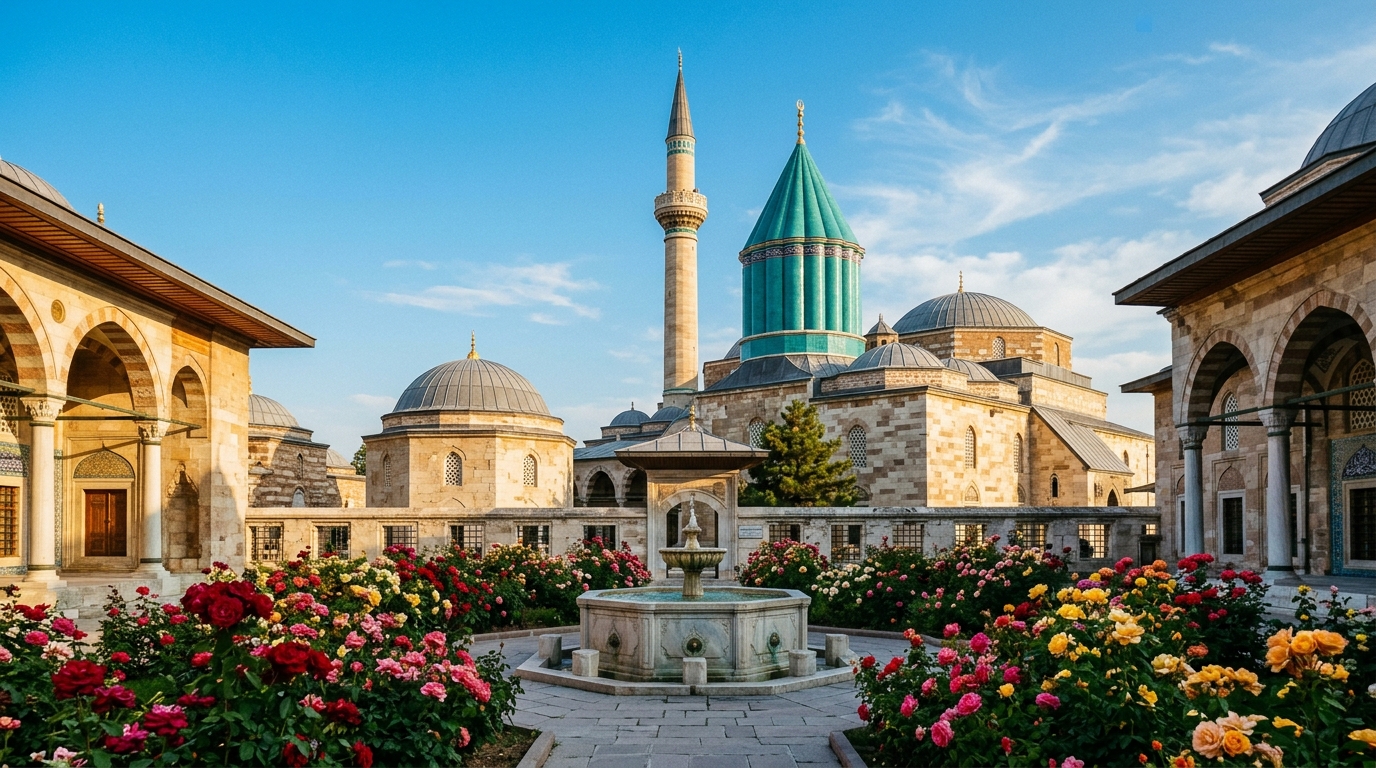
Mevlana Museum (Yeşil Kubbe)
The spiritual epicenter of Mevlevi Sufism. Dominated by the radiant turquoise-green fluted dome (Yeşil Kubbe) constructed in 1274, this sacred complex houses the tomb of Jalal al-Din Rumi, historic illuminated Masnavi manuscripts, and the revered ceremonial Semahane where whirling dervishes turn in prayer.
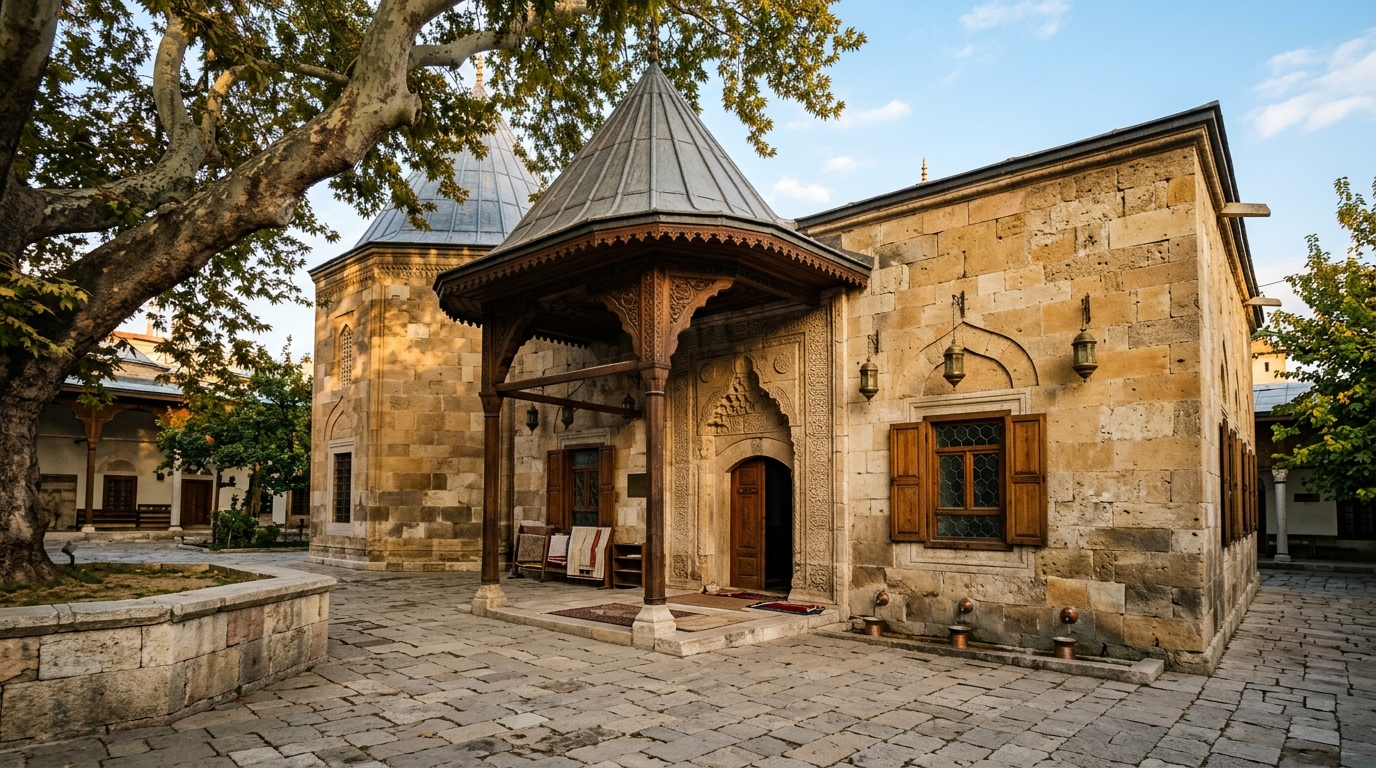
Şems-i Tebrizi Mosque & Tomb
The intimate, deeply contemplative sanctuary dedicated to Shams of Tabriz—the wandering mystic who transformed Rumi into a burning voice of divine love. Shaded by ancient plane trees, this quiet Seljuk stone shrine preserves the memory of transformative spiritual friendship.
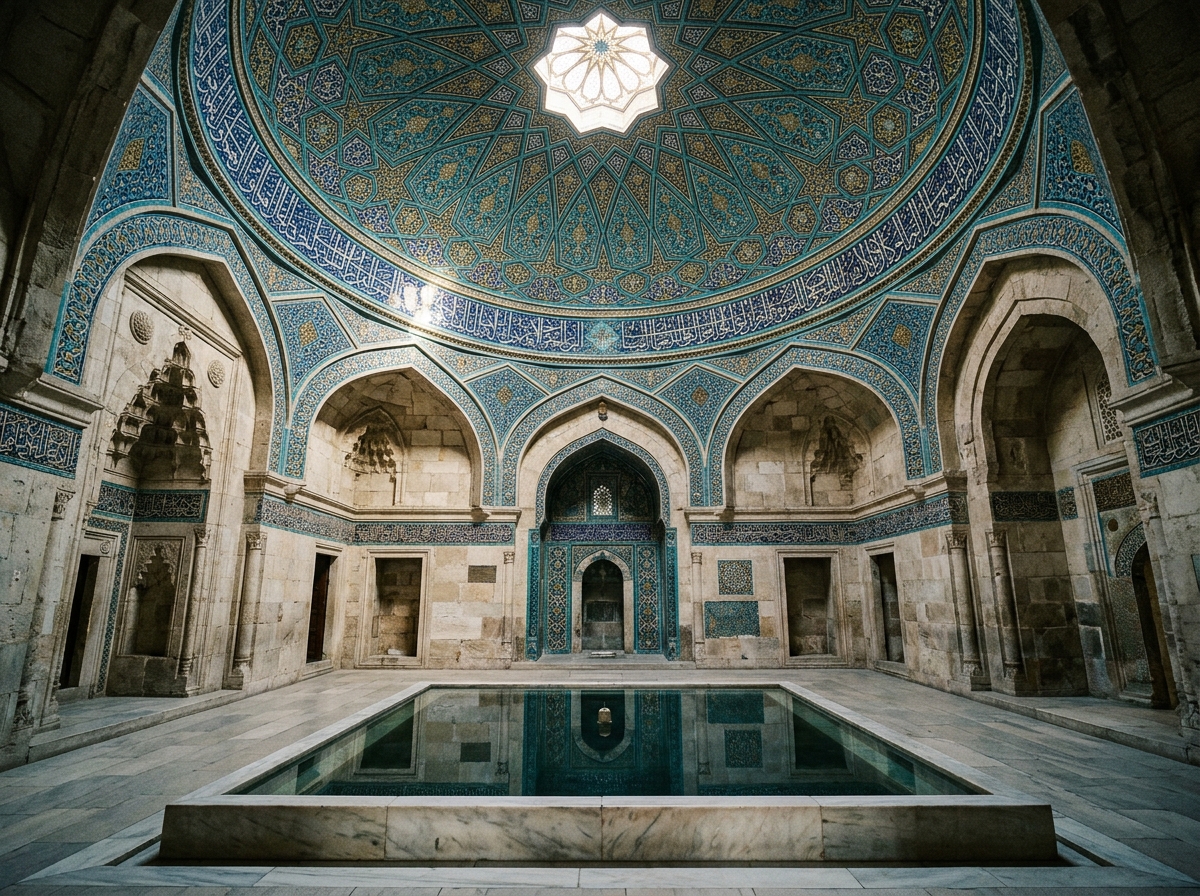
Karatay Medrese
Built in 1251 by Grand Vizier Celaleddin Karatay, this monument represents the pinnacle of Seljuk ceramic engineering. Its soaring central dome is an optical marvel of turquoise, cobalt, and gold luster tiles forming 24-point celestial starbursts reflected in a tranquil floor pool.
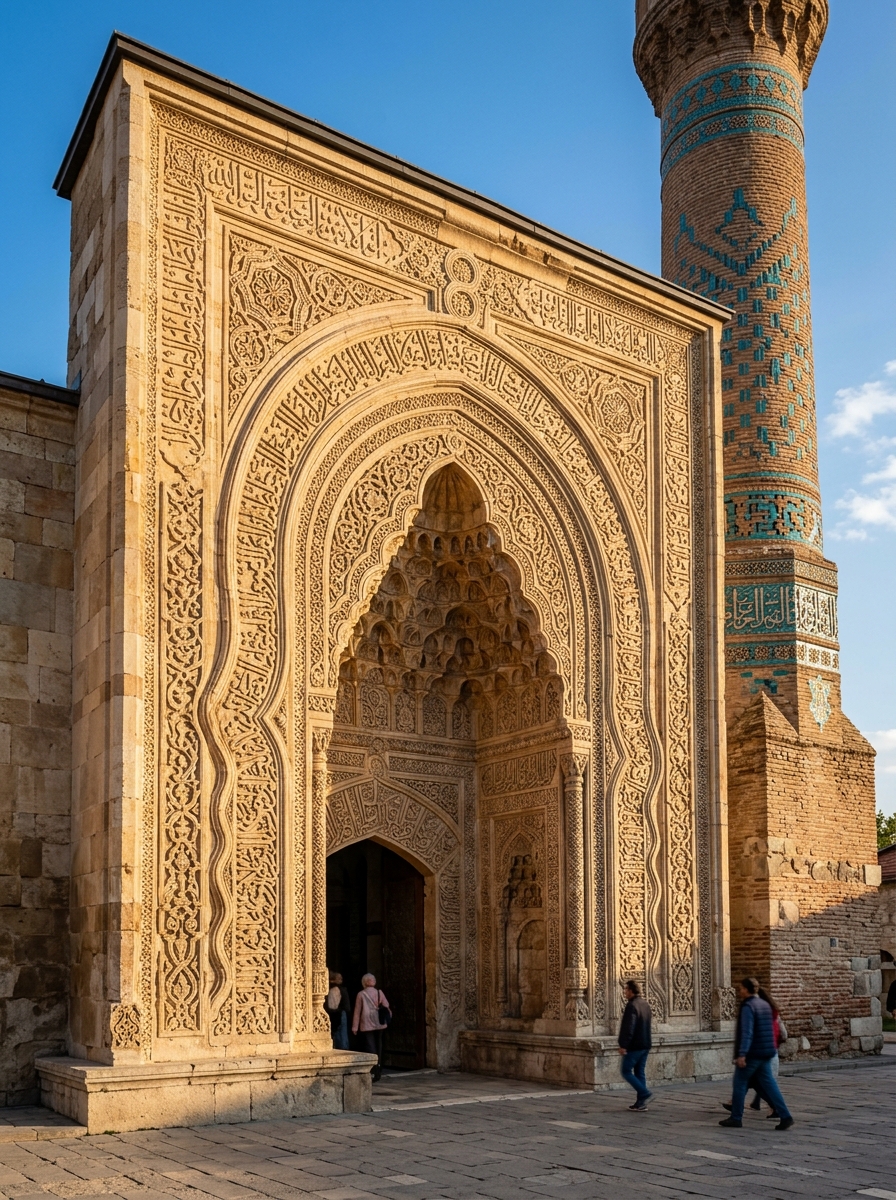
İnce Minareli Medrese
Celebrated worldwide for its breathtaking 13th-century stone entrance portal. Master architect Keluk sculpted colossal ribbon-like bands of high-relief Thuluth script weaving Surah Ya-Sin and Surah al-Fatiha across honey limestone, transforming calligraphy into sacred architecture.
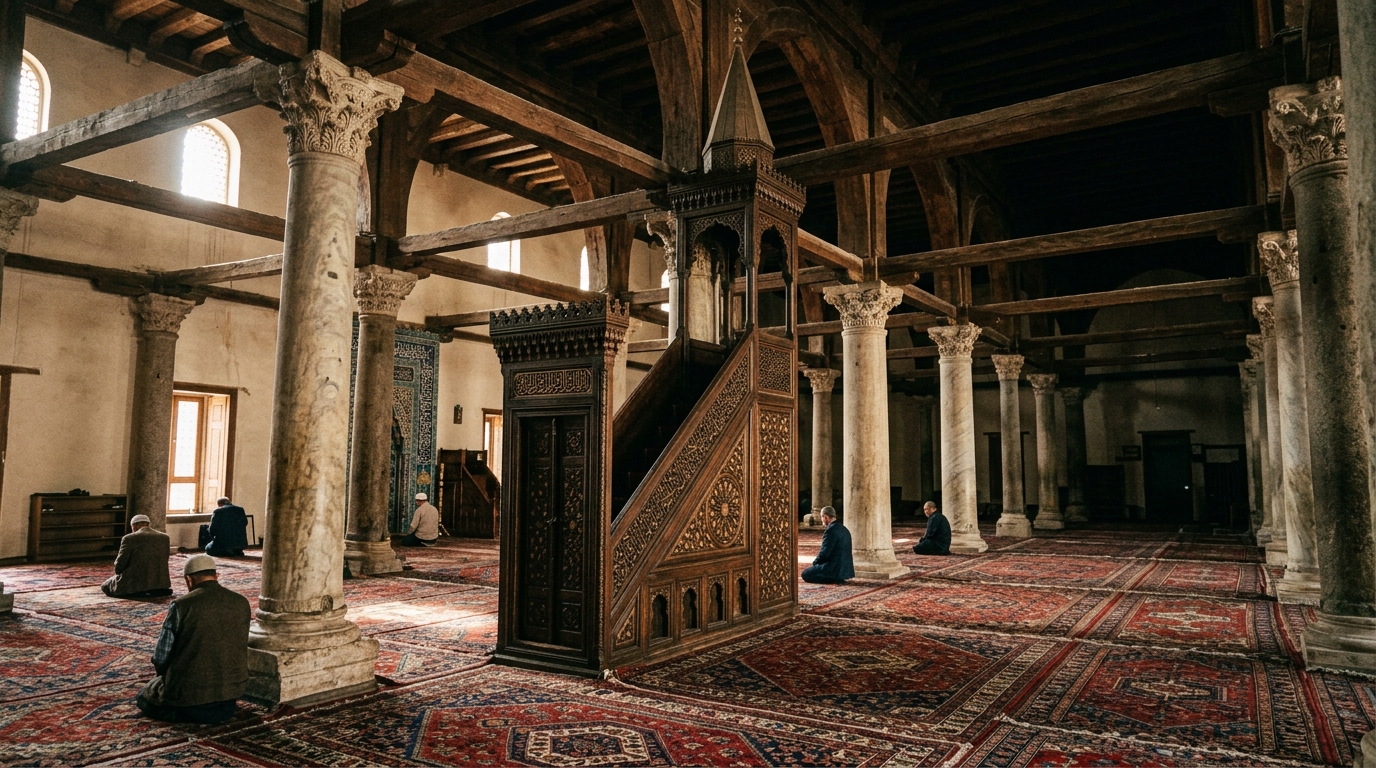
Alaeddin Mosque
Konya's oldest imperial mosque, supported by a forest of 42 antique marble columns gathered from Roman and Byzantine sanctuaries. It houses the dynastic tombs of eight Seljuk sultans and the masterpiece 1155 CE Kündekari minbar crafted from solid walnut and ebony.
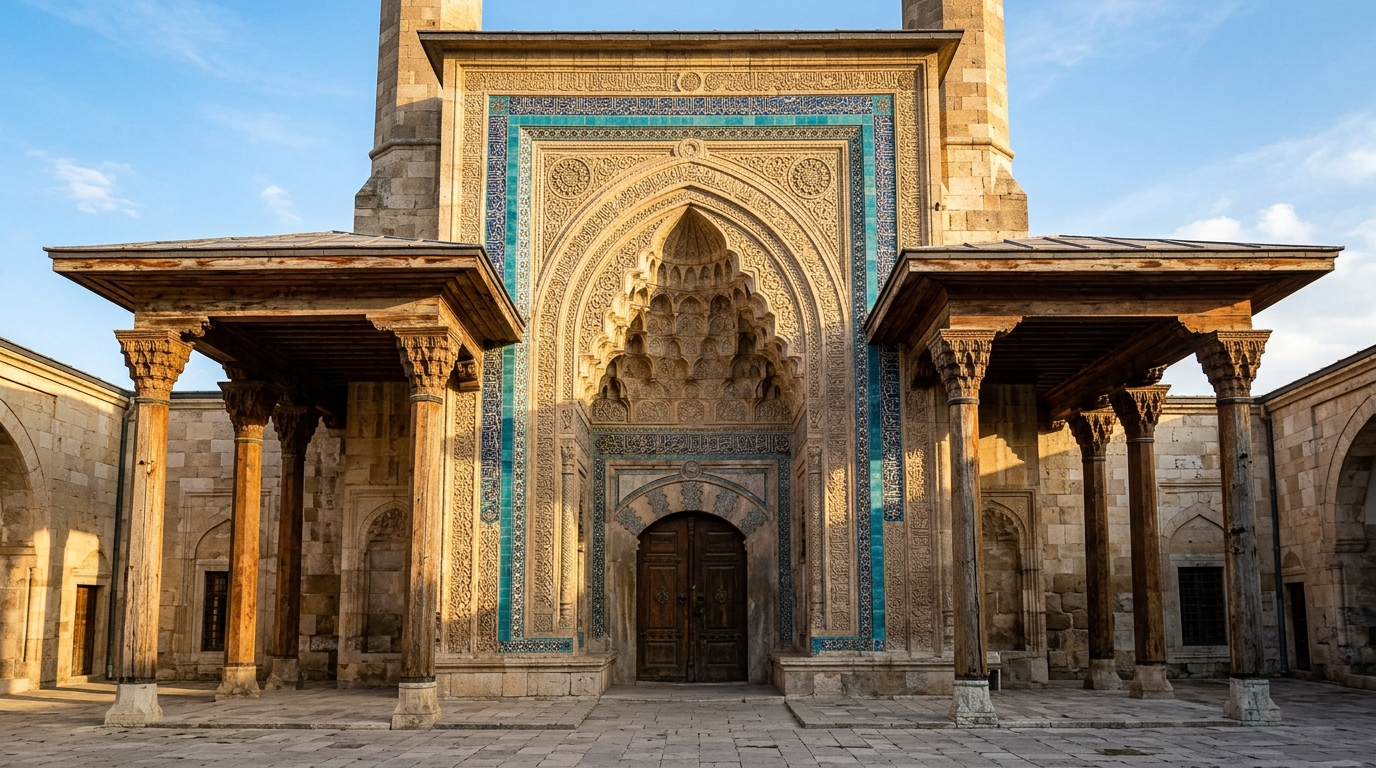
Sahip Ata Complex
Commissioned in 1258 by Seljuk Grand Vizier Sahip Ata Fahreddin Ali. The grand portal features intricate stalactite muqarnas vaulting, double minarets with turquoise brick inlay, and a dervish hospice (khanqah) paneled in turquoise hexagonal tiles with gilded rosettes.
The Sacred Craft Library
Eight essential Anatolian craft traditions, articulating the critical distinction between ordinary domestic wares and sacred devotional commissions.
Ney Making (Sacred Reed Flute)
Carved from mature Mediterranean cane (Arundo donax) aged naturally for up to five years. Fitted with a hand-turned water buffalo horn mouthpiece (Başpare) and silver collars (Parazvane), each flute is voiced and pitched to traditional modal registers (Mansur, Kız, Bolahenk).
Hüsn-i Hat (Sacred Calligraphy)
The supreme visual discipline of Islamic culture. Master scribes hand-carve river reed pens, burn olive oil soot into indelible carbon ink, and calculate every stroke proportion according to the geometric width of the pen's rhomboid dot (nokta).
Traditional Ebru (Water Marbling)
Mineral earth pigments (ochre, lapis, cinnabar) are sprinkled upon a viscous bath of water thickened with carrageenan moss gum. Controlled through ox gall and combed with rose-twig needles, no two impressions transferred to paper can ever be duplicated.
Seljuk Faience Ceramic Tilework
Master ceramists fire quartz-rich clay at 950°C, applying signature turquoise and deep cobalt glazes. Tiles are hand-cut with chisels into intricate Girih star polygons that maintain their radiant vitreous luster across eight centuries.
Mevlevi Sikke & Feltwork
Master feltmakers (Keçeci) layer raw unspun wool and camel hair, drenching the fibers with hot herbal water and kneading them manually for hours until dense, seamless, water-repellent headdresses take permanent sculptural form.
Kündekari Geometric Woodwork
An extraordinary tongue-and-groove joinery technique where hundreds of carved polygonal panels interlock purely through dry wooden grooving without a single iron nail or drop of glue, allowing timber to breathe through severe arid climate swings.
Tezhip (Classical Illumination)
Master illuminators (Müzehhib) crush 24k gold leaf into fine watercolor pigment, outlining intricate geometric strapwork and stylized floral rumi tendrils with microscopic single-hair squirrel brushes.
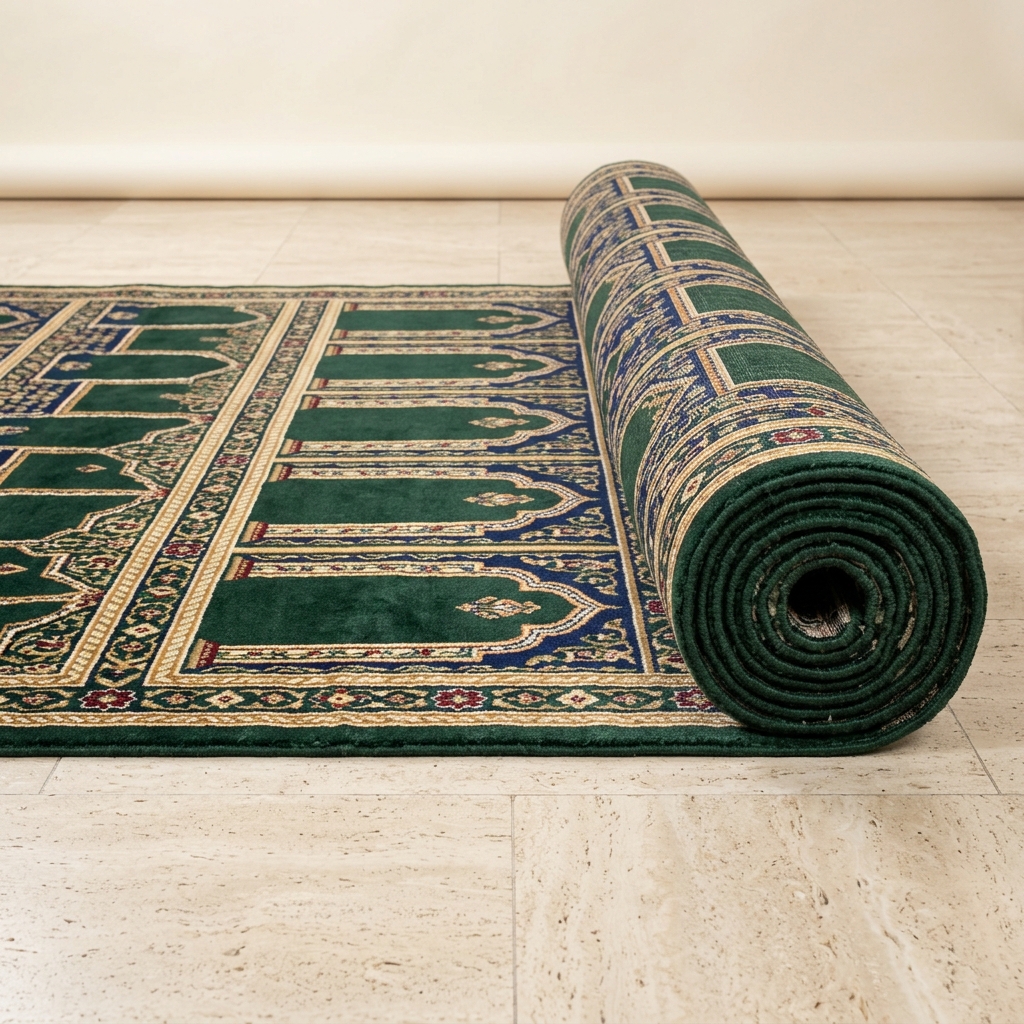
Anatolian Hand-Knotted Carpets
Woven on upright timber looms using the sturdy double Turkish knot (Gördes). Traditional Konya rugs feature stepped prayer arches, stylized tulip blossoms, and protective geometric amulets dyed exclusively with wild madder and indigo.
Unknown Hands. Enduring Legacies.
Authentic profiles of master artisans in Konya, Karatay, and Meram whose generational patience preserves Anatolian spiritual memory.
Usta Selim Koçak
"The reed is severed from its marshland home in winter cold. It must wait five years in darkness before it accepts the human breath. A master does not carve an instrument; he helps the reed weep for its original homeland."
Hattat Faruk El-Konyavi
"When I cut the river reed with my pen-knife, I am preparing my own heart. If the mind is restless, the ink bleeds. Calligraphy is not handwriting; it is geometry of the soul made visible through patience."
Fatma Zehra Aktaş
"You place colors on water with a horsehair brush. You guide them with a needle, but the water has its own will. Ebru teaches you total surrender. When the paper lifts, you see what the Divine willed to reveal."
Usta Ahmet Demirci
"No nails. No glue. Only walnut wood holding walnut wood through tongue and groove. If you put an iron nail into wood, the iron rusts and kills the tree. True Kündekari allows the wood to live for a thousand years."
The Five-Stage Provenance Journey
Establishing evidentiary trust per product—connecting Konya master ateliers with American homes through verified documentation.
Atelier Recorded
Every object is traced back to a specific registered master atelier in Konya, Meram, or Central Anatolia. We record the lead artisan, workshop location, and traditional guild lineage on our transparent sourcing ledger.
Materials Documented
We verify that raw inputs are genuine: seasoned 9-node Kargı cane from Mediterranean wetlands, pure water buffalo horn, natural earth pigments, and sustainably sourced aged Anatolian walnut.
Production Evidenced
Our custodial team documents creation milestones: cane seasoning records, acoustic tuning tests with master Neyzens, pigment grinding, and master signatures, providing photographic proof of authentic handwork.
Harmonics & Scripture Reviewed
Instruments undergo acoustic register certification (Mansur, Kız, Bolahenk), while calligraphy and tilework are reviewed by classical scholars for orthographic purity and geometric accuracy.
U.S. Fulfillment Tracked
Devotional pieces are cushioned in protective archival crates, custom-cleared with certified provenance documents, and delivered directly to American homes, studios, and interfaith sanctuaries.
Creations of Konya Devotion
Authentic, content-aware pieces handcrafted in Konya ateliers, currently available for acquisition or custom institutional commission.
Master-Crafted Mansur Ney Reed Flute
Classical Battal Ebru Sacred Calligraphy Panel
Seljuk 12-Fold Star Kündekari Wall Medallion
Hand-Painted Seljuk Faience Ceramic Star Plaque
The Reed, the Hand,
and the Heart
"Konya's heritage does not reside merely in celebrated shrines, turquoise domes, or the immortal words of Mevlana Rumi."
"It survives in a breath that still knows how to awaken a reed flute, a brush that still floats earth pigments on water, and a joiner whose interlocking timber needs neither nail nor glue to endure."
"When you hold an object crafted in Konya, you participate in eight centuries of living prayer, breathing alongside the mystics who saw the divine face in every grain of wood, drop of water, and whisper of the reed."